One system for your compliance team.

What applies, what you say, what you do, and where they differ.

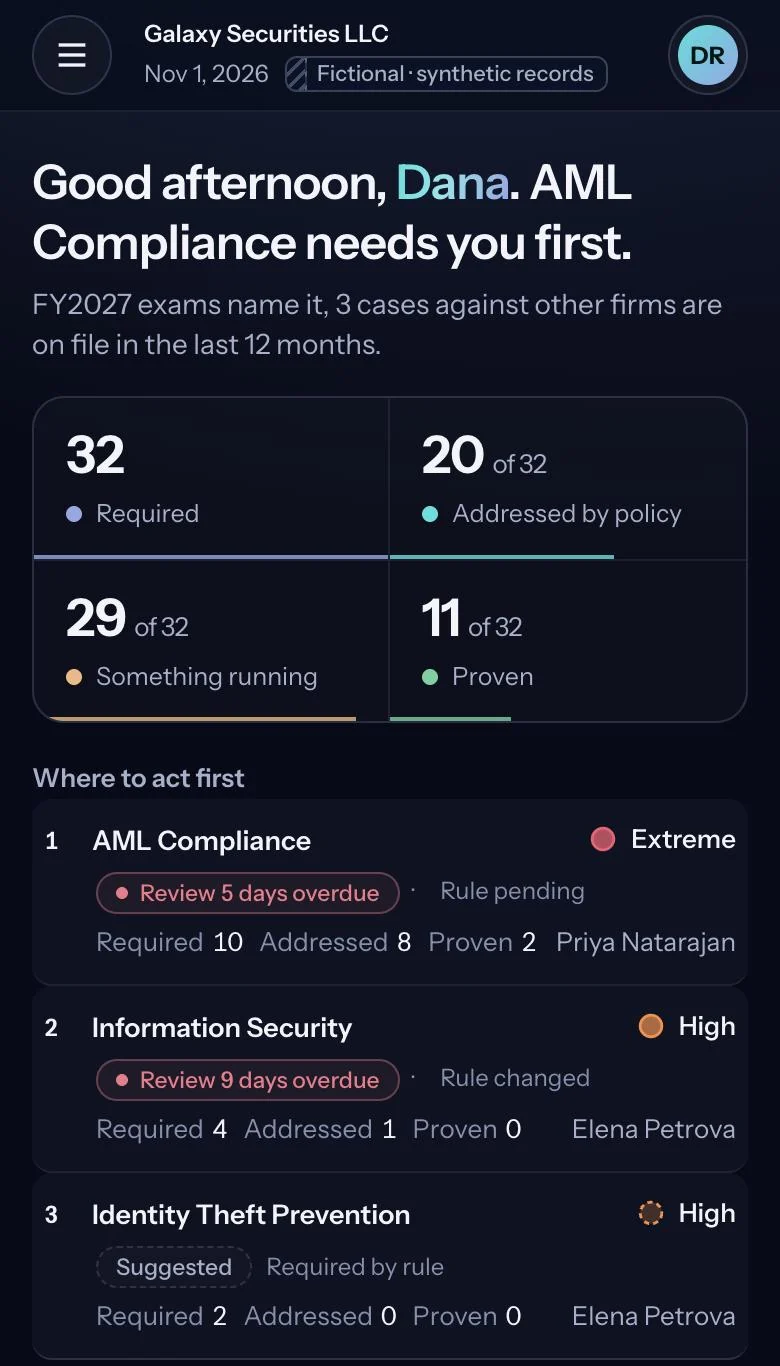
The Command screen of the product: every policy with its status, what is required, addressed and proven, its risk and its owner, ranked by where to act first.
The Reference blueprint screen: a table of requirements, each with its rule reference, its kind, the policy clause that addresses it, what is in place and its status.
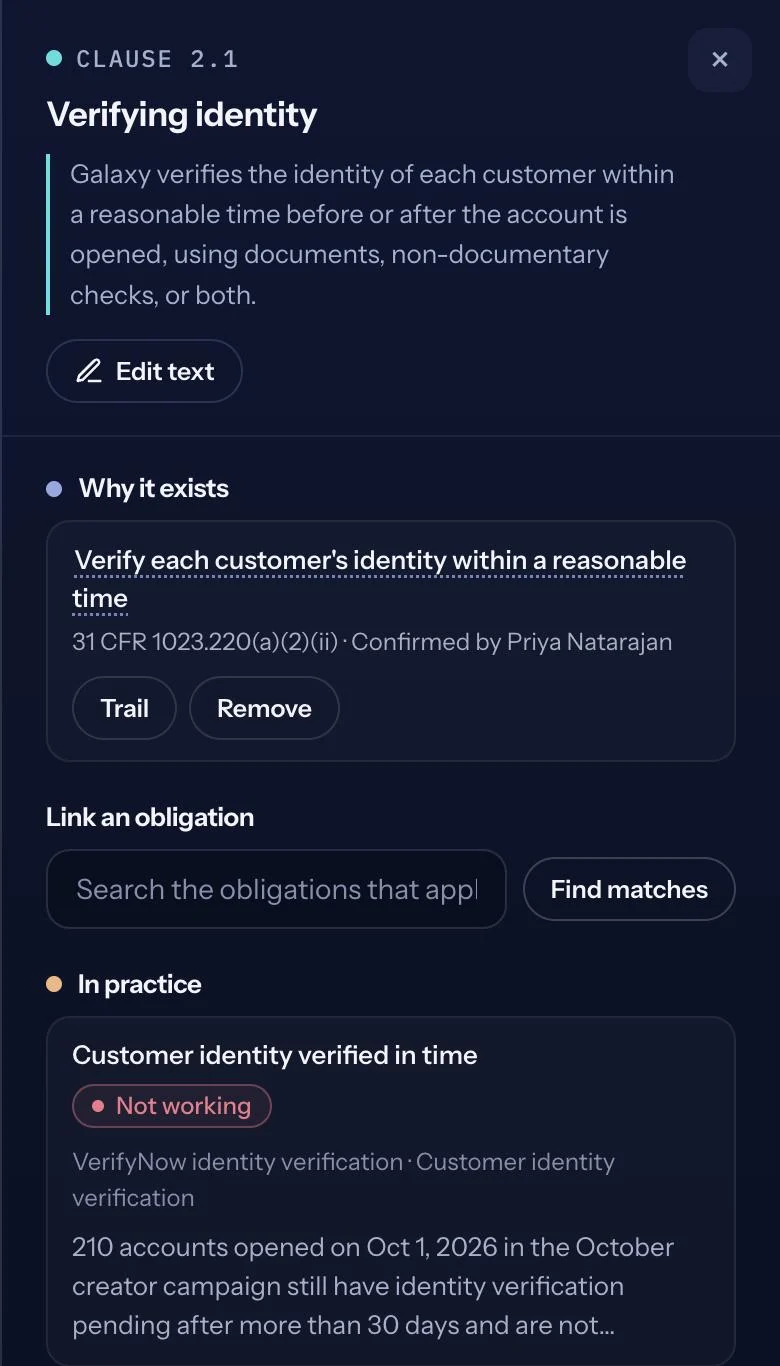
A policy open at one clause: the obligation the clause exists for, what happens in practice, and the values the clause sets.
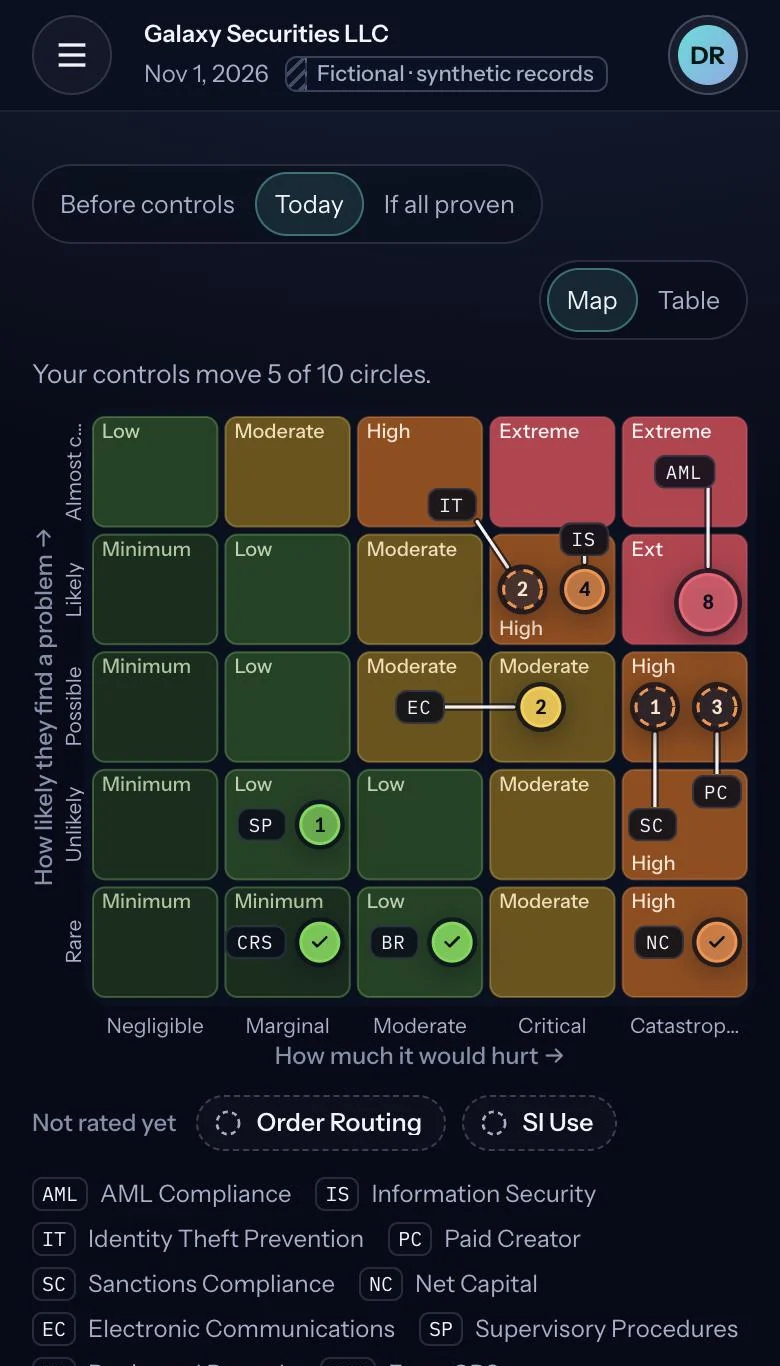
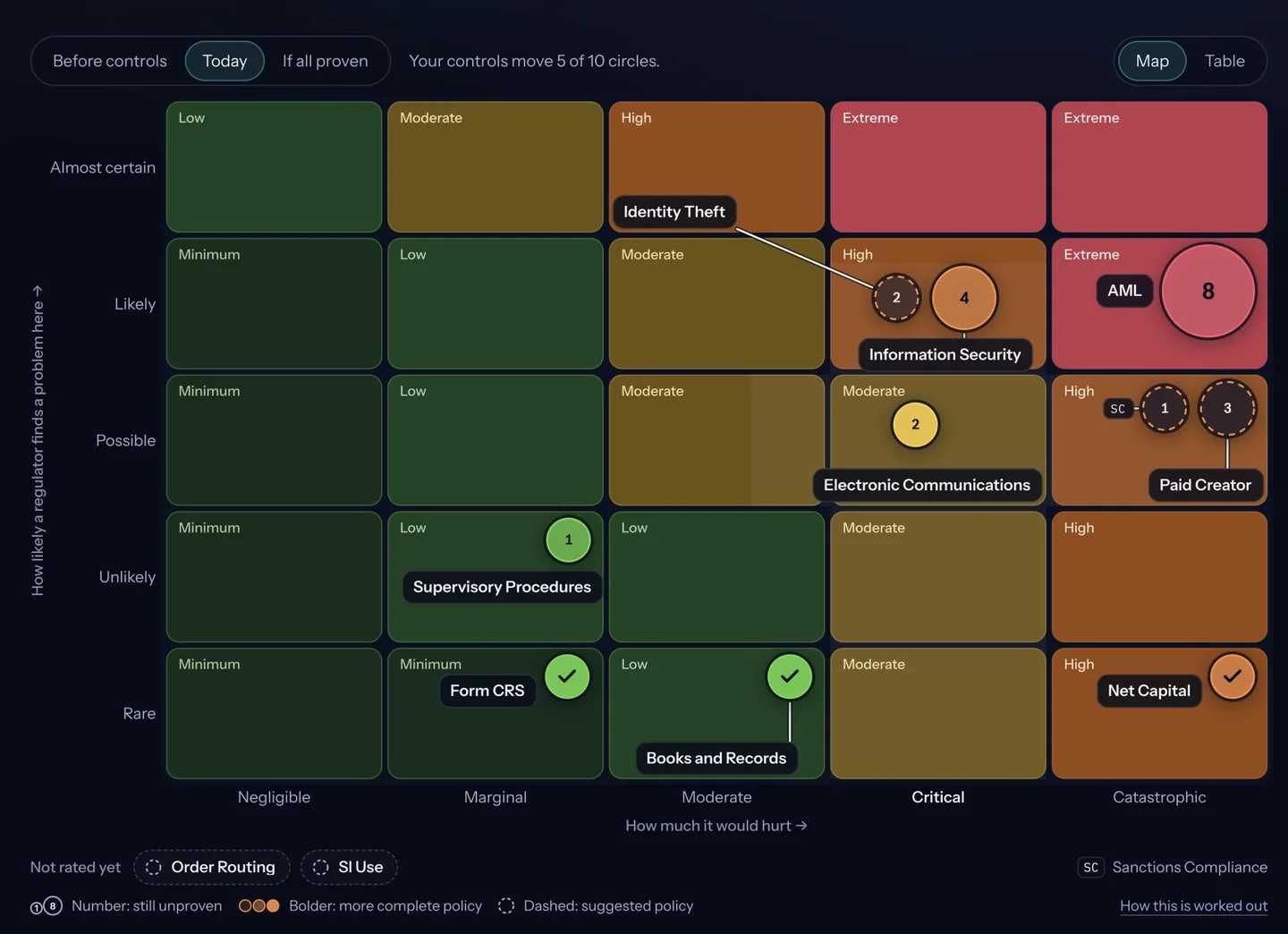
The Heat map screen: policies placed on a grid of how likely a regulator finds a problem against how much it would hurt.
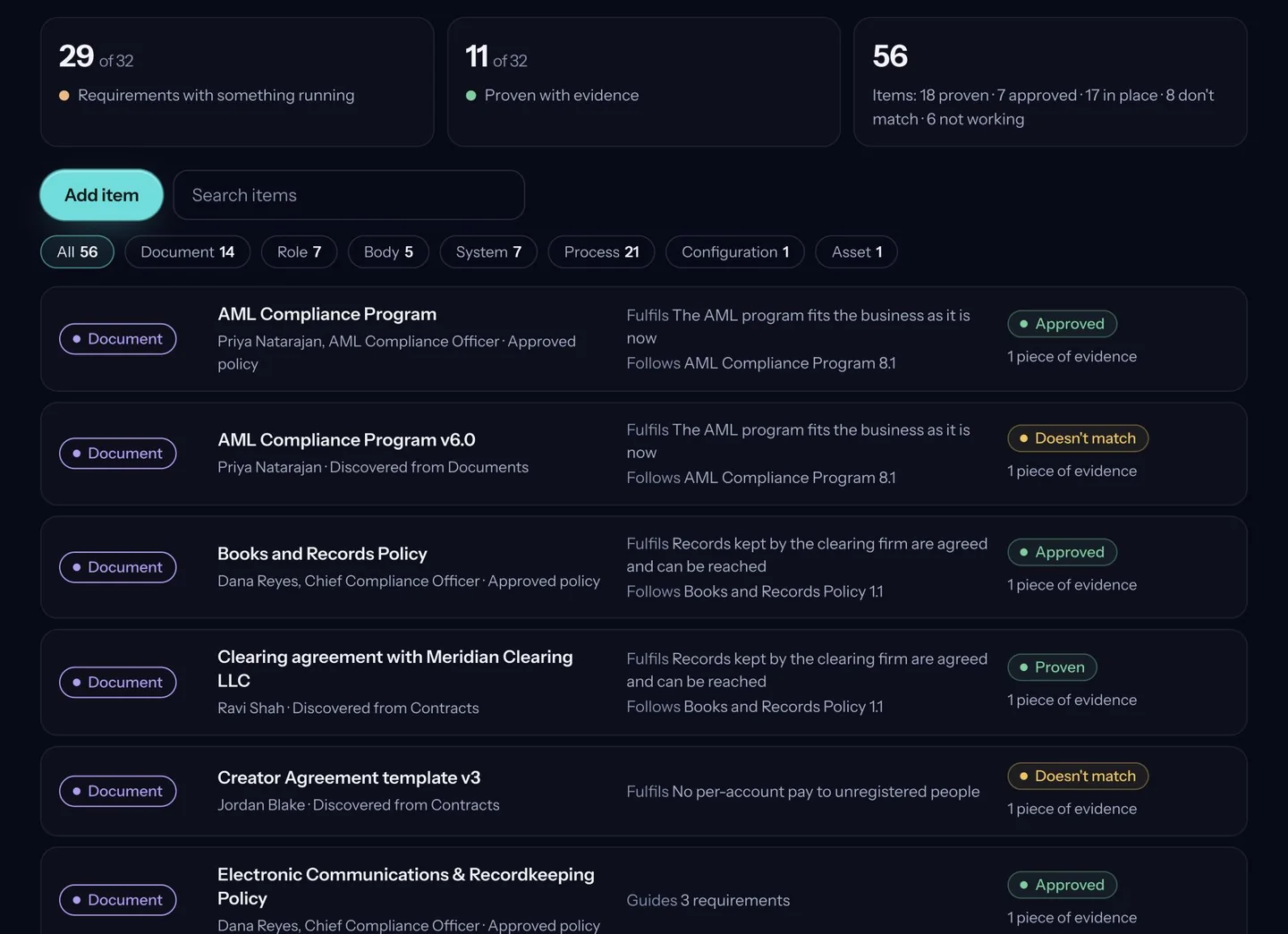
The Actual program screen: each item the firm runs, the requirement it fulfils, the clause it follows, its status and its evidence.
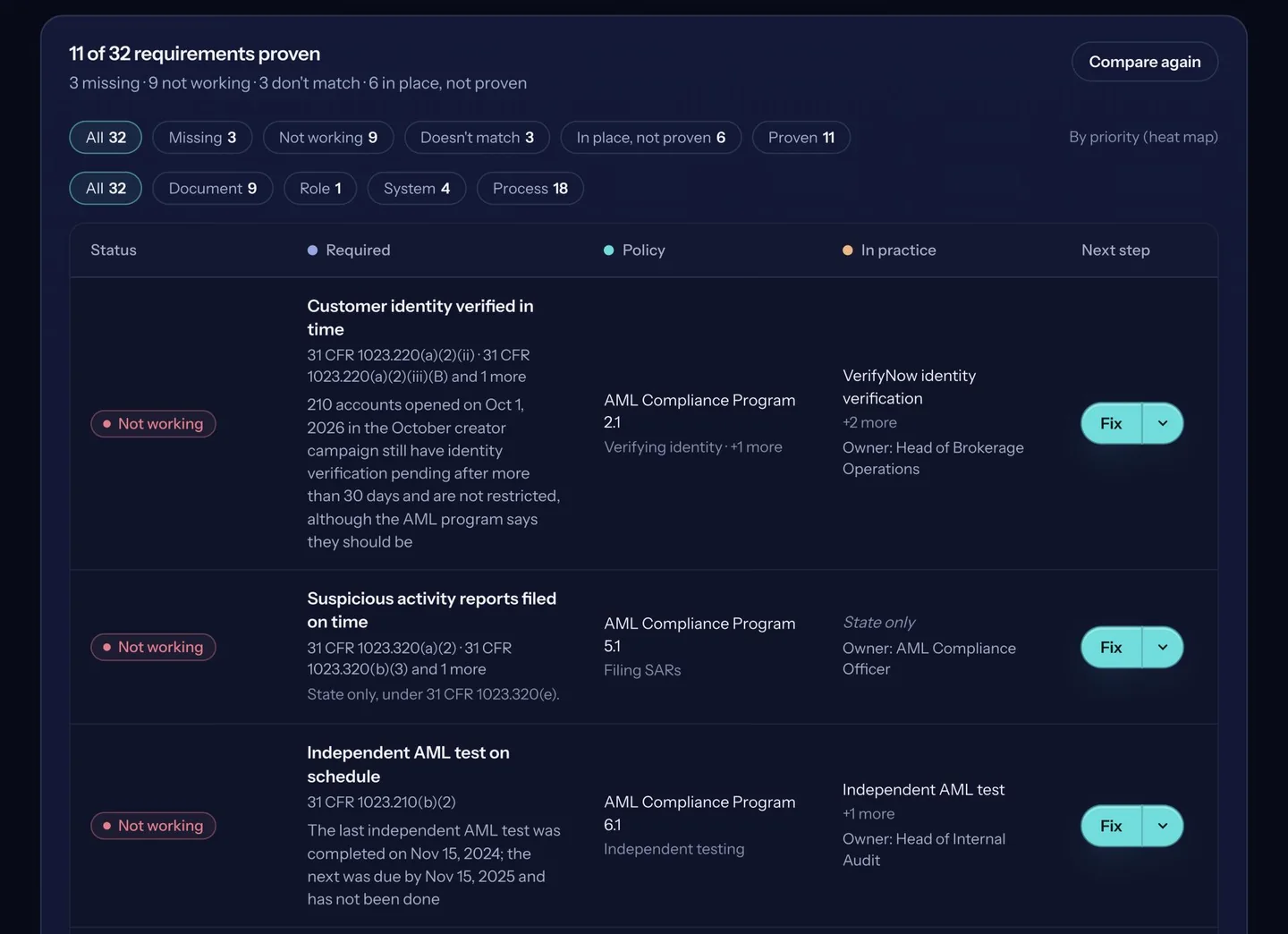
The Gaps and actions screen: each gap with what is required, what the policy says, what happens in practice, and a Fix button.

Real screens of the product. The firm, a US broker-dealer, is fictional and its records are synthetic.

In the product: What applies to you

Know what is good enough

What you must do, not only which rules apply.

  • Each requirement traced to its rule.
  • Beside it: the policy clause and its proof.
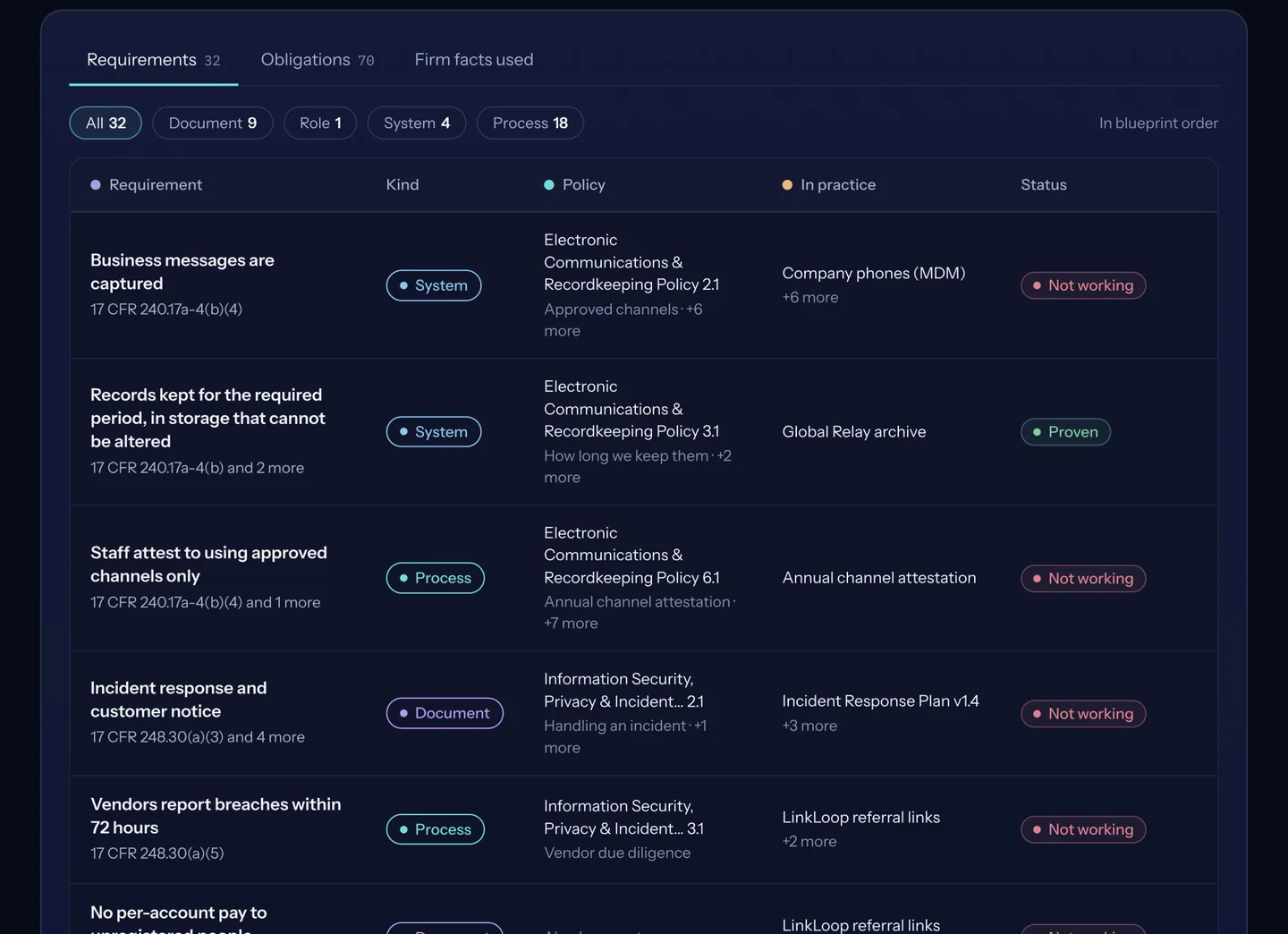
The Reference blueprint screen: a table of requirements, each with its rule reference, its kind, the policy clause that addresses it, what is in place and its status.

Swipe the table sideways to see the rest.

In the product: What you say you do

Policies in one system

Every clause linked to its obligations and controls.
  • See why each clause exists.
  • Find obligations no policy covers yet.
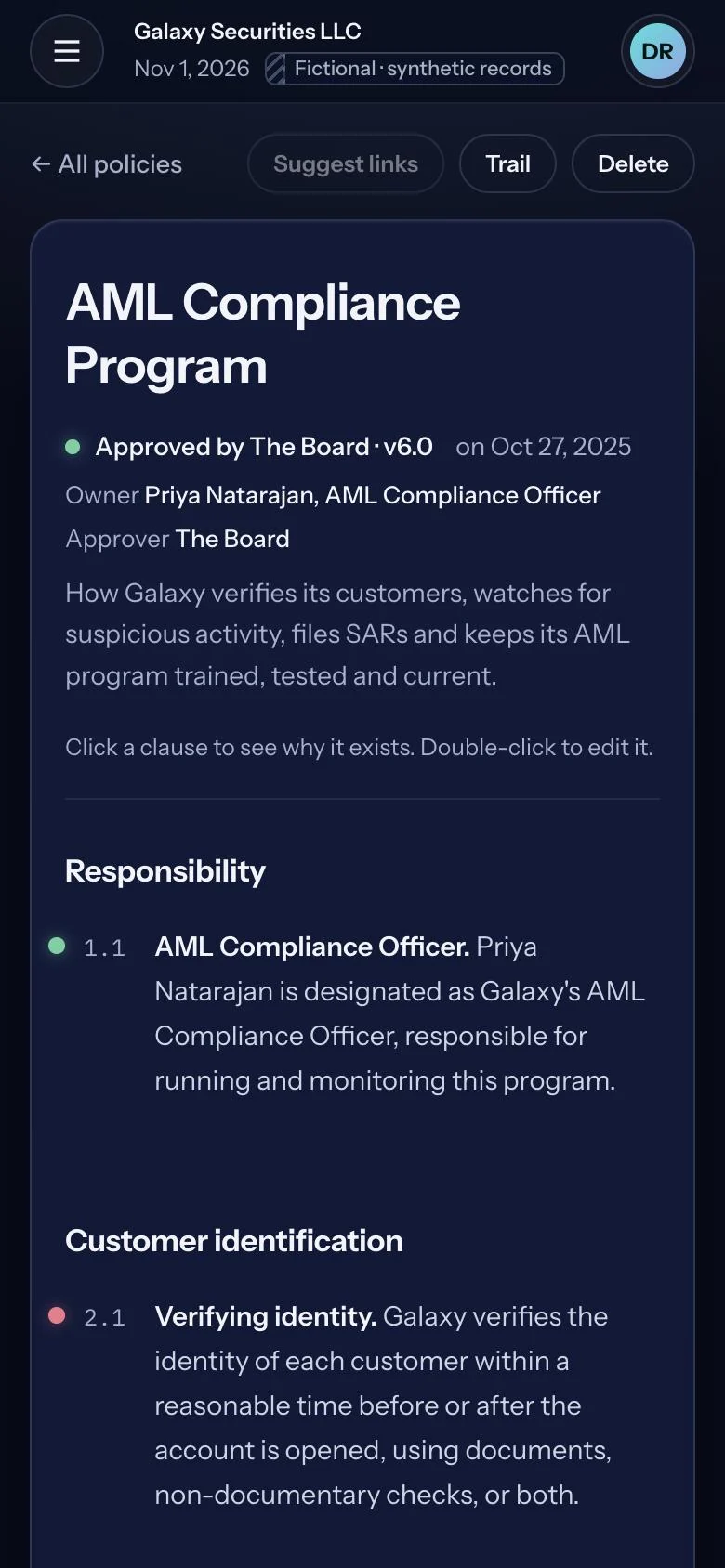
A policy on a phone: the AML Compliance Program, approved by the board, with its owner, its approver and its clauses, each marked by status.

In the product: Heat map and Command

A posture you can defend

Your risks in one heat map, with the reasoning behind each cell.
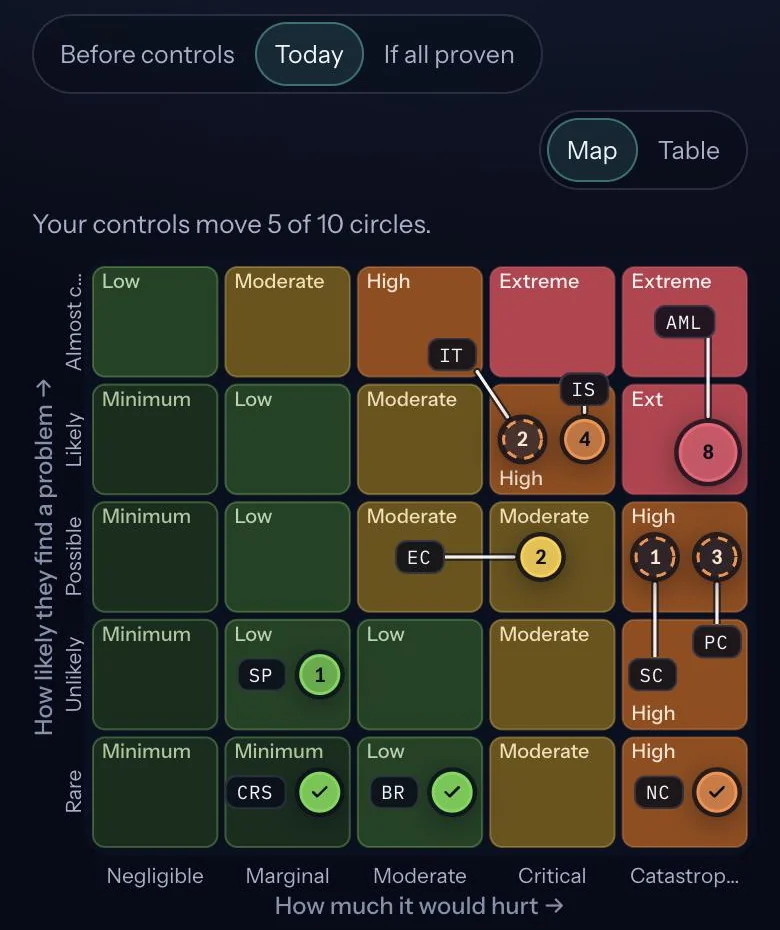
  • Before controls, today, and if all were proven.
  • Command ranks where to act first.
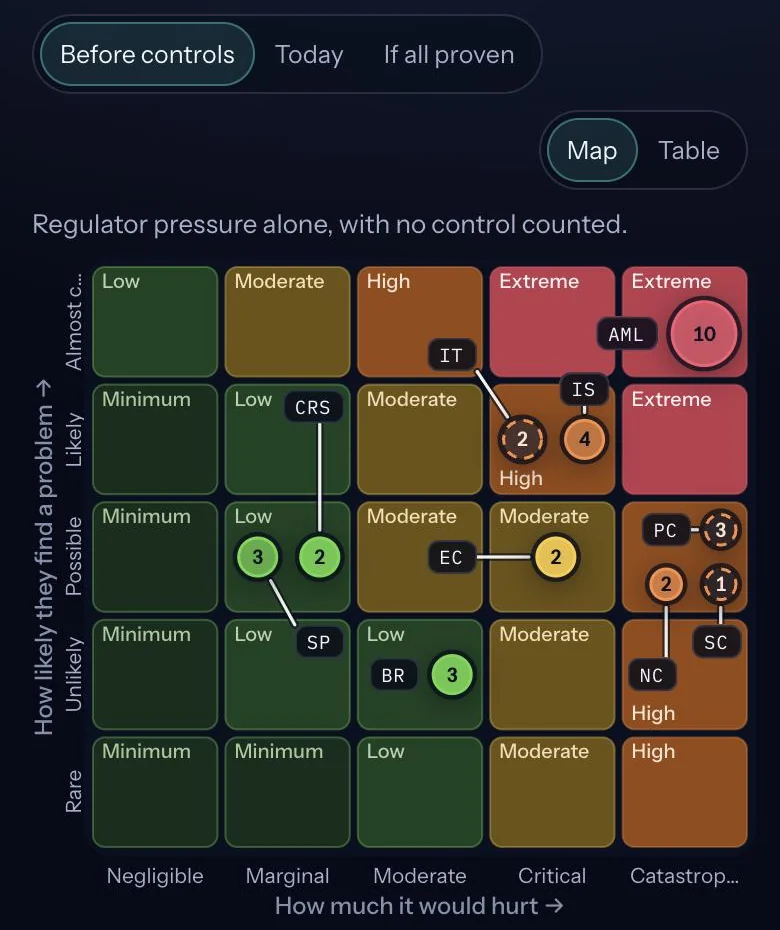
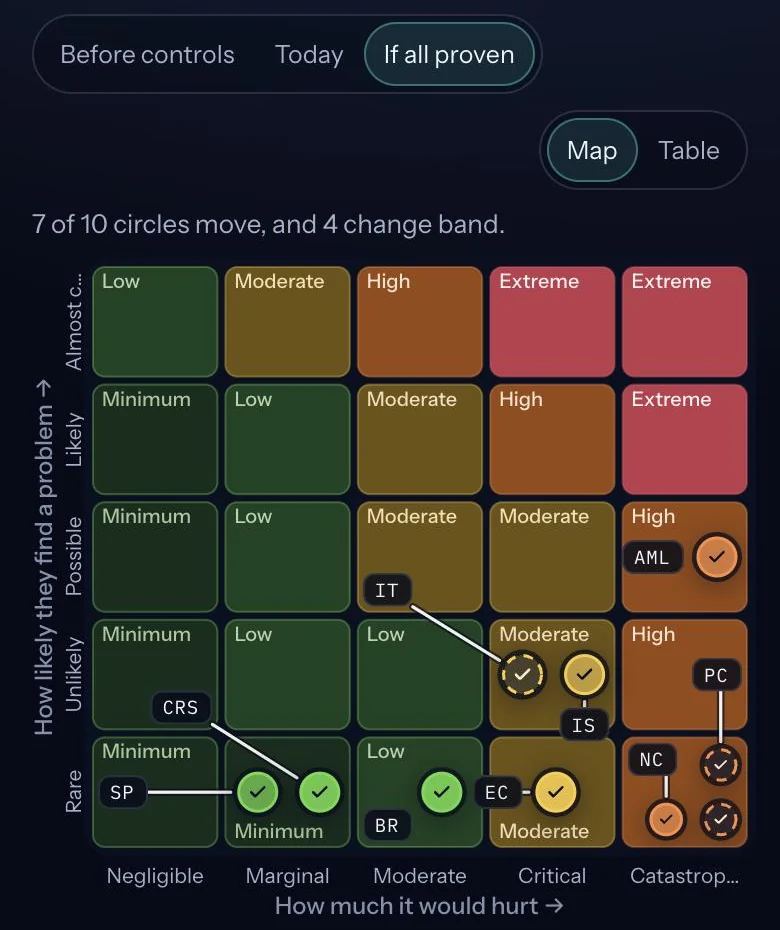
Heat map, today: your controls move 5 of 10 circles.Heat map, before controls: regulator pressure alone, with no control counted.Heat map, if all proven: 7 of 10 circles move, and 4 change band.
The Heat map screen: policies placed on a grid of how likely a regulator finds a problem against how much it would hurt.

In the product: What you actually do

The evidence behind it

What the firm runs, and proof that it works.
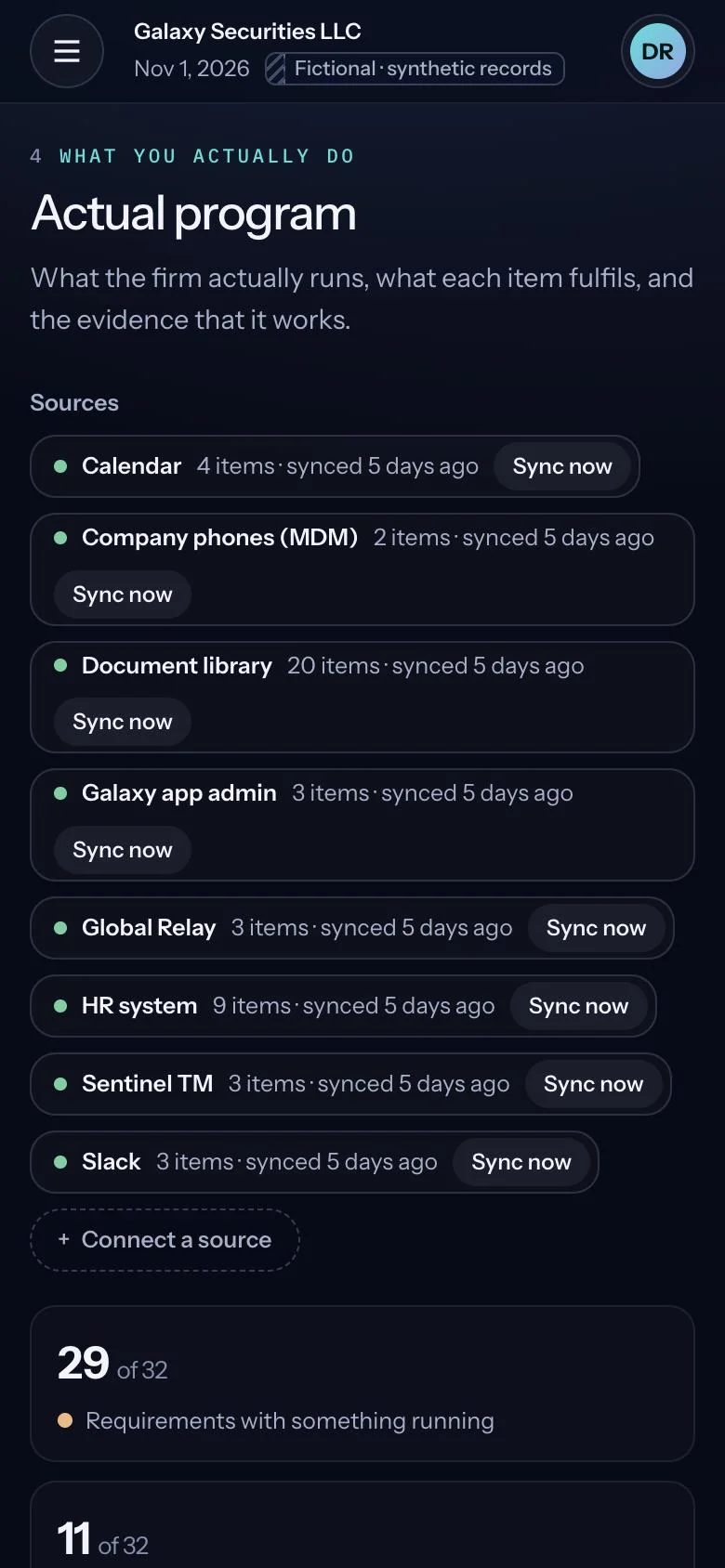
  • Records from the systems you already use.
  • Each item proven, or flagged where it falls short.
The Actual program on a phone: the sources synced from the firm’s systems, and how many requirements have something running.

In the product: Where they differ

Daily work, tracked to done

Every gap and task has an owner, from detection to done.
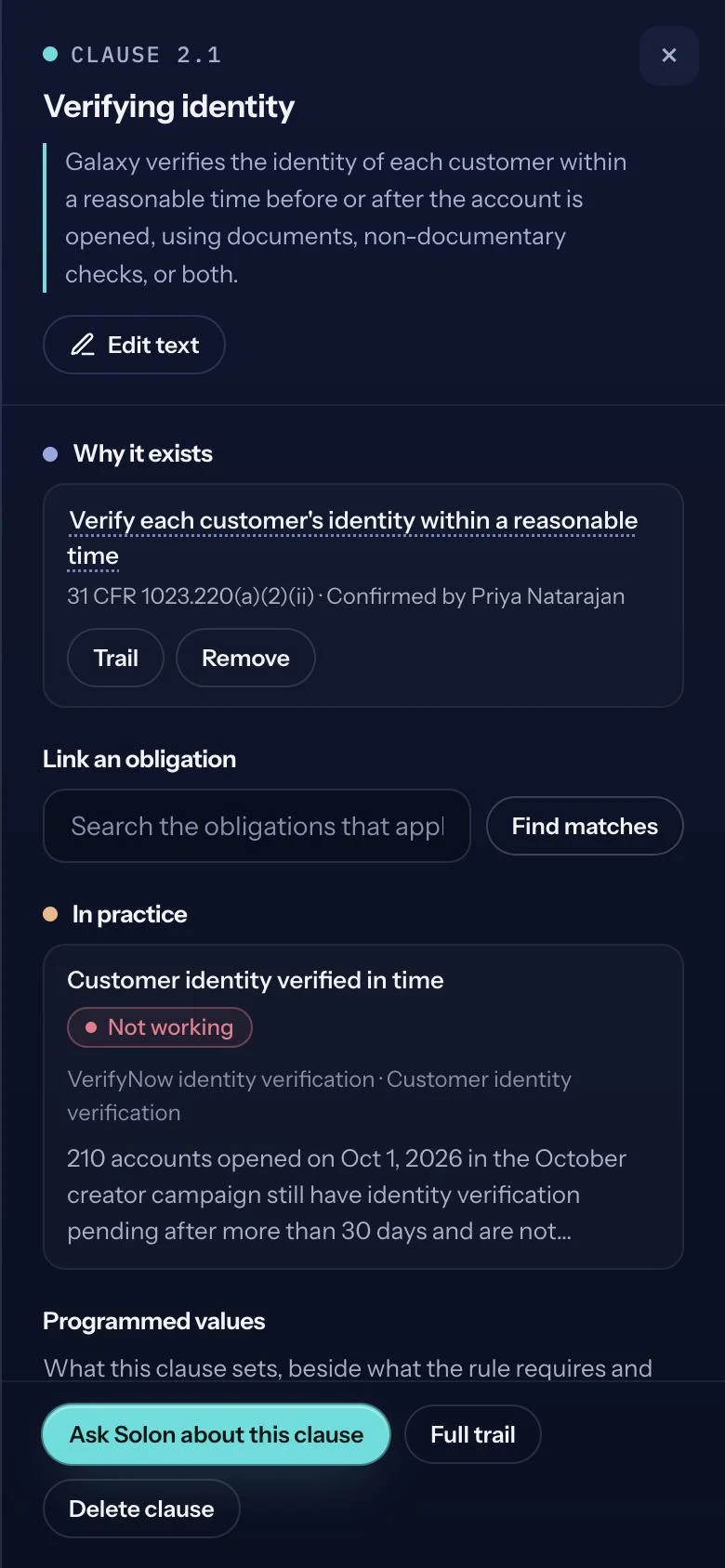
  • Each gap: the rule, the policy, the practice.
  • Fix it with a task or a workflow.
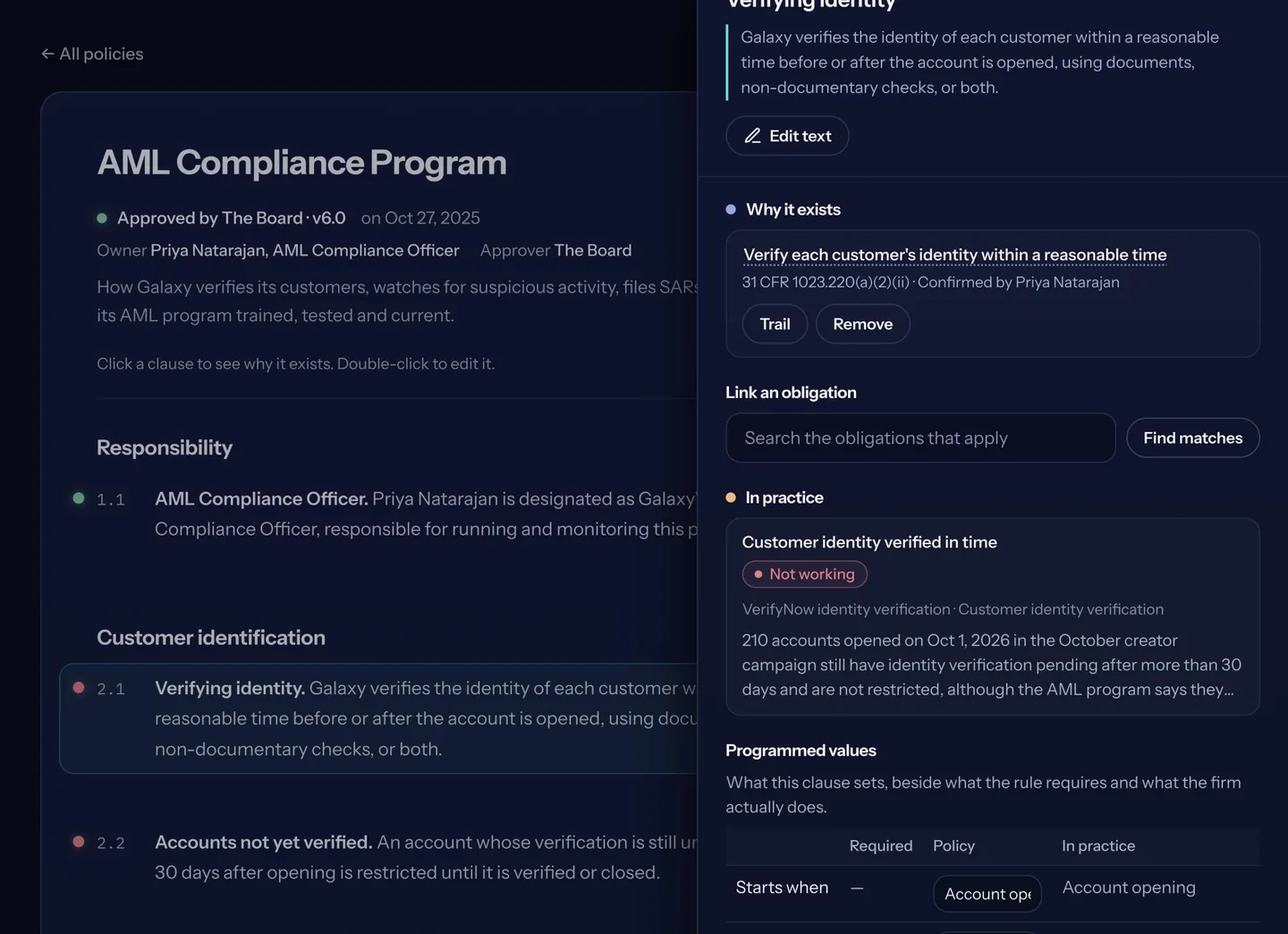
A policy clause on a phone: clause 2.1, Verifying identity, the obligation it exists for with its rule reference, 31 CFR 1023.220(a)(2)(ii), and in practice: customer identity verification is not working.
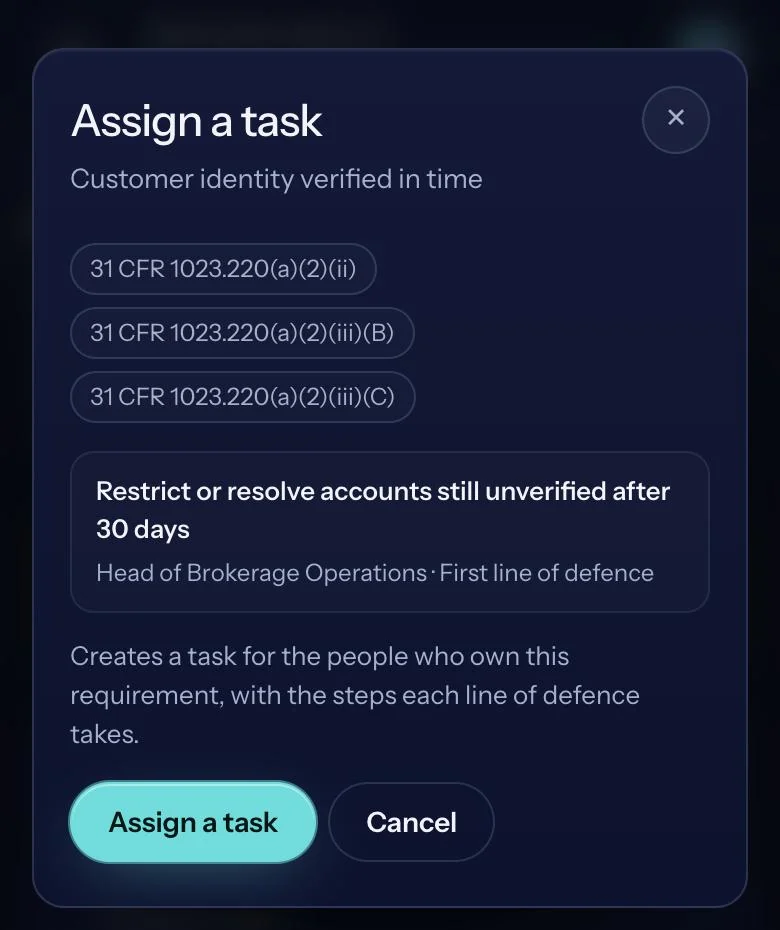
The Assign a task dialog: the requirement, its three rule references, the step “Restrict or resolve accounts still unverified after 30 days”, and its owner, the Head of Brokerage Operations, first line of defence.
The Reference blueprint screen: a table of requirements, each with its rule reference, its kind, the policy clause that addresses it, what is in place and its status.
A policy open at one clause: the obligation the clause exists for, what happens in practice, and the values the clause sets.
The Heat map screen: policies placed on a grid of how likely a regulator finds a problem against how much it would hurt.
The Actual program screen: each item the firm runs, the requirement it fulfils, the clause it follows, its status and its evidence.
The Gaps and actions screen: each gap with what is required, what the policy says, what happens in practice, and a Fix button.

Next: Solon, the AI inside it

It answers only from evidence.